Video Source
The post Come Follow My Path | Aksel Lund Svindal appeared first on Go Pro Ski.
Come Follow My Path | Aksel Lund Svindal published first on http://goproski.com/
Video Source
The post Come Follow My Path | Aksel Lund Svindal appeared first on Go Pro Ski.
Video Source
The post Ski tips for mature skiers from Silver Travel Advisor, Debbie Marshall | Iglu Ski appeared first on Go Pro Ski.
Video Source
The post Volkl Kendo Ski Review appeared first on Go Pro Ski.
Posted by MiriamEllis
This article was written jointly in partnership with Kameron Jenkins. You can enjoy her previous articles here.
When you’ve accomplished step one in your local search marketing, how do you take step two?
You already know that any local business you market has to have the table stakes of accurate structured citations on major platforms like Facebook, Yelp, Infogroup, Acxiom, and YP.
But what can local SEO practitioners do once they’ve got these formal listings created and a system in place for managing them? Our customers often come to us once they’ve gotten well underway with Moz Local and ask, “What’s next? What can I do to move the needle?” This blog post will give you the actionable strategy and a complete step-by-step tutorial to answer this important question.
Listings on formal directories are called “structured citations.” When other types of platforms (like online news, blogs, best-of lists, etc.) reference a local business’ complete or partial contact information, that’s called an “unstructured citation.” And the best unstructured citations of all include links, of course!
For example, the San Francisco branch of a natural foods grocery store gets a linked unstructured citation from a major medical center in their city via a blog post about stocking a pantry with the right ingredients for healthier eating. Google and consumers encounter this reference and understand that trust and authority are being conveyed and earned.
The more often websites that are relevant to your location or industry link to you within their own content, the better your chances of ranking well in Google’s organic and local search engine results.
Link building is as old as organic SEO. Structured citation building is as old as local SEO. Both practices have long sought to influence Google rankings. But a close read of the local search marketing community these days points up an increasing emphasis on the value of unstructured citations. In fact, local links were one of the top three takeaways from the 2018 Local Search Ranking Factors survey. Why is this?
Your goal with linked unstructured citations is to build your community footprint and your authority simultaneously. All you need is the right tools for the research phase!
For the sake of this tutorial, let’s choose at random a small B&B in Albuquerque — Bottger.com — as our hypothetical client. Let’s say that the innkeeper wants to know how the big Tribal resort casinos are earning publicity and links, in the hopes of finding opportunities for a smaller hospitality business, too. *Note that these aren’t absolutely direct competitors, but they share a city and an overall industry.
We’re going to use Moz’s Link Intersect tool to do this research for Bottger Mansion. This tool could help Bottger uncover all kinds of links and unstructured linked citation opportunities, depending on how it’s used. For example, the tool could surface:
A client may already know who the “big fish” in their community are, or you can cast a net by identifying popular local events and seeing which businesses sponsor them. Sponsorships can be pricey, depending on the event, so if a local company sponsors a big event, it’s an indication that they’re a larger enterprise with the budget to pursue a wide array of creative PR ideas. Larger enterprises can serve as models for small business emulation, at scale.
In our case study, we know that Bottger is located in Albuquerque, so we decided to locate sponsors of the famous Albuquerque International Balloon Fiesta. Right away, we spotted two lavish Albuquerque resort-casinos — Isleta and Sandia. These are the “big fish” we want our smaller client to look to for inspiration.
We’re going to compare Bottger’s domain to Isleta and Sandia’s domains. In Moz Pro, navigate to “Link Explorer” and then select “Link Intersect” from the left navigation. Input your domain in the top and the domains you want to mine link ideas from in the fields beneath, as depicted below.
Open Link Explorer in a new tab
Next to Bottger’s domain, we’ve selected “root domain” as that will show us all competitor links who haven’t linked to us at all. We’re also going to select “root domain” on the resort domains, so we can see all of their backlinks, rather than just links to particular pages on their sites.

Moz’s Link Intersect tool will let you compare your site with up to 5 competitors. It’s totally up to you how many sites you want to evaluate at once. If you’re just getting started with link building, you may want to start with just one domain, as this should yield plenty of link opportunities to start with. If you’ve already been doing some link building, you have more time to dedicate to link building, or you’d just generally rather have more options to work with, go ahead and put in multiple domains to compare.
Once you’ve input your domain and your competitor(s) domains, click “Find Opportunities.” That will yield a list of sites that link to your competitors, but do not link to you.

In this example, we’re comparing our client’s domain against two other domains: A (Isleta) and B (Sandia). In the “Sites that intersect” column, you will see whether Site A has the link, Site B has it, or if they both have it.
Now that we have a list of link ideas from Isleta and Sandia’s backlink profiles, it’s time to decide which ones might yield good opportunities for our B&B. That’s right — just because something is in a competitor’s link profile doesn’t necessarily mean you want it!
The first step is to drill down and get more detail about links the big resorts have. Select the arrow to expand this section and view the exact page the link is coming from.

In this example, both Sandia and Isleta have links from the root domain marriott.com. By using the “expand” feature, we can see the exact pages those links are located on.
You can use the MozBar Chrome plugin to view whether your competitor’s link is no-followed or followed. Since only followed links pass authority, you may want to prioritize those, but no-followed links can also have value in the form of generating traffic to your site and could get picked up by others who do eventually link to your site with a follow link.
Select the MozBar icon from your browser and click the pencil icon. If you want to see Followed links, select “Followed” and the MozBar will highlight these links on the page in green. To find No-Followed links, click “No-Followed” and MozBar will highlight these links on the page in pink.

Common types of links you’ll see in the profiles of local business websites
If this is your first foray into link building for local businesses, you may be unfamiliar with the types of sites you’ll see in Link Intersect. While no two link profiles are exactly the same, many local businesses use similar methods for building links, so there are some common categories to be aware of. Knowing these will help you decipher the results Link Intersect will show you.
Press releases
Press release sites like PRweb.com and PRnewsire.com are fairly common among local businesses that want to spread the word about their initiatives. Whether someone at the business won an award or they started a new community outreach program, local businesses often pay companies like PRweb.com to distribute this news on their platform and to their partners. These are no-followed links (don’t pass link authority aka “SEO value”) but they can offer valuable traffic and could even get picked up by sites that do link with a follow link.
If your competitor is utilizing press releases, you may want to consider distributing your newsworthy information this way!
Structured citations / directories
One of the primary types of domains you’ll see in a local business’ backlink profile is directories — structured citation websites like yellowpages.com that list a business’ name, address, and phone number (NAP) with a link back to the business’ website. Because they’re self-created and not editorially given, like Press Releases, they are often no-followed. However, having consistent and accurate citations across major directory websites is a key foundational step in local search performance.
If you see these types of sites in Link Intersect, it may indicate your need for a listings management solution like Moz Local that can ensure your NAP is accurate and available across major directories. Typically, you’ll want to have these table stakes before focusing on unstructured linked citations.
News coverage
Another favorite among local businesses is local media coverage (or just media coverage in general — it’s not always local). HARO (Help a Reporter Out) is a popular service for connecting journalists to subject matter experts who may be valuable sources for their articles. The journalists will typically link your quote back to your website. Aside from services like HARO, local businesses would do well to make media contacts, such as forming relationships with local news correspondents. As news surfaces, they’ll start reaching out to you for comment!
If you see news coverage in your competitor’s backlink profile, you can get ideas of what types of publications want content and information that you can provide.
Local / industry coverage
Blogs, hobby sites, DIY sites, and other platforms can feature content that depicts city life or interest in a topic. For example, a chef might author a popular blog covering their dining experiences in San Francisco. For a local restaurant, being cited by this publication could be valuable.
If you see popular local or industry sites in your competitor’s backlink profile, it’s a good signal of opportunity for your business to build a relationship with the authors in hopes of gaining links.
Trade organizations
Most local businesses are affiliated with some type of governing/regulating body, trade organization, award organization, etc. Many of these organizations have websites themselves, and they often list the businesses they’re affiliated with.
If your competitor is involved with an organization, that means your business is likely suited to be involved as well! Use these links to get ideas of which organizations to join.
Community organizations
Community organizations are a great local validator for search engines, and many local businesses have taken notice. You’ll likely find these types of organizations’ websites in your competitor’s backlink profile, such as Chamber of Commerce websites or the local YMCA.
As a local business, your competitors are in the same locale as you, so take note of these community organizations and consider joining them. You’ll not only get the benefit of better community involvement, but you can get a link out of it too!
Sponsorships / event participation
Local businesses can sponsor, donate to, host or participate in community events, teams, and other cherished local resources, which can lead to both online and offline publicity.
Local businesses can earn great links from online press surrounding these groups and happening. If an event/team page highlights you, but doesn’t actually link to benefactors/participants, don’t be shy about politely requesting a link.
Scholarships / .edu sites
A popular strategy used by many local businesses and non-local businesses alike is scholarship link building. Businesses figured out that if they offered a scholarship, they could get a link back to their site on education websites, such as .edu domains. Everyone seemed to catch on — so much so that many schools stopped featuring these scholarships on their site. It’s also important to note that .edu domains don’t inherently have more value than domains on any other TLD.
If your business wants to offer a scholarship, that is a great thing! We encourage you to pursue this for the benefit it could offer students, rather than primarily for the purpose of gaining links. Scholarship link building has become very saturated, and could be a strategy with diminishing returns, so don’t put all your eggs in this basket, and do it first and foremost for students instead of links.
Other businesses
Businesses may sometimes partner with each other for mutually beneficial link opportunities. Co-marketing opportunities that are a byproduct of genuine relationships can present valuable link opportunities, but link exchanges are against Google’s quality guidelines.
Stay away from “you link to me, I’ll link to you” opportunities as Google can see it as an attempt to manipulate your site’s ranking in search, but don’t be afraid to pursue genuine connections with other businesses that can turn into linking opportunities.
Spam
Just because your competitor has that link doesn’t mean you want it too! In Link Intersect, pay attention to the domain’s Spam Score and DA. A high spam score and/or low DA can indicate that the link wouldn’t be valuable for your site, and may even harm it. 
Also watch out for links generated from comments. If your competitor has links in their backlink profile coming from comments, you can safely ignore these as they do not present real opportunities for earning links that will move the needle in the right direction.
Now that you’re familiar with popular types of local backlinks and what you can do with them, let’s actually dig into Isleta and Sandia’s backlinks to see which might be good prospects for us.
Both the Albuquerque Marriott and Hilton Garden Inn link to Isleta and Sandia on their “Local Things to Do” pages. This could be a great prospect for Bottger! In many cases, “things to do” pages will include lists of local restaurants, historic sites, attractions, shops, and more. Note how their addresses are included on the following pages, making them powerful linked unstructured citations. Bottger hosts fancy tea parties in a lovely setting, which could be a fun thing for tourists to do.

Isleta and Sandia also have links from a wedding website. If Bottger uses their property as a wedding venue, offers special wedding or engagement packages, or something similar, this could be a great prospect as well.

Link Intersect also yielded links to various travel guide websites. There are plenty of links on websites like these to local attractions. In the following example, you can see an Albuquerque travel guide that’s broken up by category, “hotels” being one of them:

Isleta and Sandia also have been featured in the Albuquerque Journal. In this example, a local reporter covered news that Isleta was opening expanded bingo and poker rooms. This seems to be a journalist who covers local businesses, so she could be a great connection to make!

Many other links in Isleta and Sandia’s backlink profiles came from sources like events websites, since these resorts are large enough to serve as the venue for major events like concerts and MMA matches. Although Bottger isn’t large enough to host an event of that magnitude, it could spark good ideas for link building opportunities in the future. Maybe Bottger could host a small community tea tasting event featuring locally sourced herbal teas and get in touch with a local reporter to promote it. Even competitor links that you can’t directly pursue can spark your creativity for related link building opportunities.
And let’s not forget how we found out about Isleta and Sandia in the first place: the Albuquerque International Balloon Fiesta! Event sponsors are featured on an “official sponsors” page with links to their websites. This is a classic, locally relevant opportunity for any Albuquerque business.

If you’re thinking, “This sounds great, but it also sounds like a lot of work. How am I ever going to keep track of all this?” — we’ve got you covered!
Moz Pro’s “Link Tracking Lists” was built for just this purpose.
In Link Intersect, you’ll see little check boxes next to all your competitors’ links. When you find one you want to target, check the box. When you’re done going through all the links and have checked the boxes next to the domains you want to pursue, click “Add to Link Tracking List” at the top right.

Since we’ve never done link building for Bottger before, we’re going to select “Create New List” from the dropdown, and label it something descriptive.

Make sure to put your client’s domain in the “target URL” field. For Step 3, since we’ve just selected the links we want to track from Link Intersect, those will already be populated in this field, so no further action is needed other than to click “Save.”

We’ll come back to Link Tracking Lists when we talk about outreach, but for now, all you need to know is that you can add the desirable competitor links (in our case, links from Isleta and Sandia) to Link Tracking lists straight from Link Intersect, making it easy to manage your data.
Now it’s time to connect the dots: how do you go from knowing about your competitor’s links to getting those types of links for yourself?
There are three main ways you can get unstructured linked citations to your local business’ website, and those categories are what’s going to dictate the strategy you need to take to secure that opportunity for yourself.
Since this tutorial is about proactively pursuing link opportunities, we’re going to focus on unstructured linked citations types one and two.
If your competitor has been featured in an article from say a local journalist or blogger, then your outreach will be focused on making a connection with that writer or publication for future link opportunities, rather than getting the exact link your competitor has. That’s because the article has already been written, so it’s unlikely that the writer will go back and edit their story just to add your link.
The one exception to this rule would be if the article links to your competitor, but your competitor’s link is now broken. In this scenario, you could reach out to the writer and say something like, “Hey! I notice in your article [article title] you link to [competitor’s link], but that link doesn’t seem to be working. I have similar content on my website [your URL]. If you find it valuable, please feel free to use it as a replacement for that broken link!”
Sometimes the contact information of the writer will be right next to the article, itself. For example:

If there’s no email address or contact form in the writer’s bio, you can usually find a link to one of their social media accounts, like Twitter, and you can connect with them there via a public or direct message. If you live in a small, tight-knit community, you may even be able to meet with the author in person.
If you notice your competitors are issuing a lot of press releases and you want to try that out for yourself, you’ll likely need to sign up for an account, as these are a primarily self-serve platform. Most quality press release sites charge per release, and the price can differ depending on length.

You’ll either want to sign up for a citation service like Moz Local that distributes your data to these types of listings programmatically, or if you do it manually, you’ll want to find the link to create your listings. Please note that your business may already be on the directory even if you haven’t set up a profile. Before creating a new listing, search for your business name and its variants, your phone number, and current and former addresses to see if there are existing listings you can claim and update.

Most businesses will make it easy to contact them. If you’re trying to contact another business for the purpose of proposing teaming up for a co-marketing opportunity, look in their footer (the very bottom of the website). If there’s no contact information there, search for a “Contact Us” or “About” page. You may not find an email address, but you may be able to find a contact form or phone number. Below is an example from Albuquerque Little Theater, where they have contact information on the right and advertising information in the top navigation for businesses that are interested in taking out ads in their printed show programs. Not an unstructured linked citation, but a great way to get your business known to the community!

Most organizations will make it easy for those who want to join, unless they are more exclusive or invitation-only. In the event that you do wish to get involved in an invitation-only organization that has no public-facing contact information, try viewing a member list and seeing if there’s anyone you know. Or maybe you know someone who can introduce you to one of the members. Genuine connections are key for this type of organization.

Outreach emails are necessary when the link opportunity you’re pursuing isn’t a link you could create yourself, or if the link source is one where you can’t make face-to-face contact with decision-makers. One of the most important questions you should be asking yourself for these opportunities is, “Why would this website link to me?”
Here’s how Bottger might go about sending an outreach email:
|
Greeting that matches the nature of the outreach target |
“Hey Jill!” might be fine when outreaching to the author of a blog, while “Hello Ms. Smith” might be better for more professional outreach. |
|
Introduction |
Give a brief summary of who you are, what you do, and your interest in contacting them. For example: “I work with Bottger Mansion, a historic Bed & Breakfast in Old Town Albuquerque. I found your page about Albuquerque activities — you’ve really captured a lot of what Albuquerque has to offer!” |
|
The ask, and the value add |
This is where you’ll actually ask for the link. It’s a good idea here to add value. Don’t just ask for something; offer to give something back! To continue the same example: “As long-time residents of Old Town, we’d love to provide you with a comprehensive list of activities in the city’s historic district! We feel an Old Town Activities list would be a great addition to your page. Bottger Mansion regularly hosts high tea, for example, which we’d love to let more people know about with a spot on your list!” |
|
Close |
Wish them well, thank them for their time, and sign off. Make sure that it’s easy for them to find information about you by including your full name, title, organization, and website/social links in your email signature. |
Don’t be afraid to get on the phone, either! Hearing your voice can add a human element to the outreach attempt and offer a better conversion rate than a more impersonal email (we all get so many of those a day that ones from people we don’t know are easy to ignore).
And remember that local businesses have a particular advantage in accruing unstructured linked citations. Lively participation in the life of your community can continuously introduce you to decision-makers at popular local publications, paving the way towards neighborly outreach on your part. Learn to see the opportunities and think of ways your business can add value to the content that is being written about your town or city.
Next-to-last, we’re going to jump back to Link Tracking Lists for a second, because that’s going to come in extremely handy here. Remember when we created the list with Sandia and Isleta’s links that we were interested in pursuing? Those will now show up when we go to Moz Pro > Link Explorer > Link Tracking Lists.

Every time Bottger successfully secures a link that they’ve added to their Link Tracking List, the red X in “Links to target URL?” column will turn blue, indicating that the site links to Bottger’s root domain. If we were pursuing links to individual pages, and a link prospect linked to our target page, the red X would turn green.
Another handy feature is the “Notes” dropdown. This allows you to keep track of your outreach attempts, which can be one of the trickiest parts about link building!

Before starting this process for yourself, familiarize yourself with these four risks so that your fishing trip doesn’t result in a basket of bad catches that could waste your resources or get your website penalized.
Link Intersect can be amazingly helpful for discovering new, relevant link opportunities for your local business, but link builders beware. If all you ever do is copy your competitors, the most you’ll ever achieve is becoming the second-best version of them. Use this method to keep tabs on strategies your competition is using, and even use it to spark your own creativity, but avoid copying everything your competitors do, and nothing else. Why be the second-best version of your competition when you can be the best version of yourself?
Comparing your site’s backlink profile with your direct competitors’ backlink profiles will return a list of links that they have and you don’t, but don’t use Link Intersect results as an exact checklist of links to pursue. Your competitors might have bad backlinks in their profile. For example, avoid pursuing opportunities from domains with a high Spam Score or low Domain or Page Authority (DA/PA). Learn more about how to evaluate sites by their Spam Score or DA/PA.
They might also have great backlinks that aren’t the right opportunity for your business, and those should be avoided too! Do you remember Isleta and Sandia’s links for events like MMA matches? If Bottger were to blindly take those resorts’ link profiles as directives, they might think they have to host a fight at their B&B, too!
Take what you find with a grain of salt. Evaluate every link opportunity on its own merit, rather than deeming it a good opportunity simply because your competitor has it.
Choose the domains and pages you want to compare yourself against wisely. As a small local B&B, Bottger wouldn’t want to compare their backlink profile to that of Wikipedia or The New York Times, for example. Those sites are popular, but not relevant in any way to the types of unstructured linked citations Bottger would want to pursue, such as links that are locally relevant or industry-relevant.
In other words, just because a site is popular doesn’t mean it will yield relevant unstructured linked citation opportunities for you. Here in this tutorial, we’ve outlined one potential use-case for Link Intersect: finding unstructured linked citations your local business competitors have. However, this is not the only use for Link Intersect. Instead of comparing your site against competitors or near-competitors, you could compare it against:
If you know what types of links you’re trying to find, choosing sites to evaluate against your own should be a lot easier, and yield more relevant opportunities.
If you’ve never embarked on link building before, we encourage you to read through Google’s quality guidelines for webmasters, specifically its section on “Link schemes.” If you were to distill those link guidelines down into a single principle, it would be: don’t create links for the purpose of manipulating your site’s ranking in Google search. That’s right. Google doesn’t want anyone embarking on any marketing initiatives solely for the purpose of improving their ranking. Google wants links to be the natural byproduct of the quality work you’re doing for your audience. Google can penalize sites that participate in activities such as:
This underscores that the activities that are just good business, like being involved in the local community, are also the ones that can produce the links that Google likes. Sites owners might need a little nudge, which is why we’ve included a section on outreach, but that doesn’t mean the links are unnatural. Unstructured linked citations should be a byproduct of the good work local businesses are doing in their communities.
At Moz, we’re strong believers in authenticity, and there is no better pond for building meaningful marketing relationships than the local one. Focusing on unstructured linked citations can be viewed as a prompt to grow your community relationships — with journalists, bloggers, event hosts, business associations, and customers. It’s a chance for a real-world fishing trip that can reel in a basket of publicity for your local brand beyond what money can buy. Your genuine desire to serve and build community will stand you in good stead for the long haul.
Sign up for The Moz Top 10, a semimonthly mailer updating you on the top ten hottest pieces of SEO news, tips, and rad links uncovered by the Moz team. Think of it as your exclusive digest of stuff you don’t have time to hunt down but want to read!
Video Source
The post Kids Ski Lesson at the Snow Centre, Hemel Hempstead appeared first on Go Pro Ski.
Posted by Jeff_Baker
Grab yourself a cup of coffee (or two) and buckle up, because we’re doing maths today.
Again.
A quick refresher from last time: I pulled data from 50 keyword-targeted articles written on Brafton’s blog between January and June of 2018.
We used a technique of writing these articles published earlier on Moz that generates some seriously awesome results (we’re talking more than doubling our organic traffic in the last six months, but we will get to that in another publication).
We pulled this data again… Only I updated and reran all the data manually, doubling the dataset. No APIs. My brain is Swiss cheese.
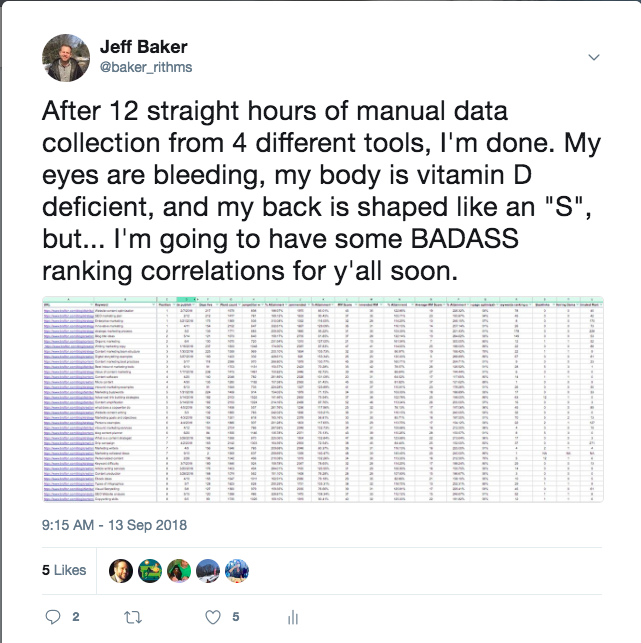
We wanted to see how newly written, original content performs over time, and which factors may have impacted that performance.
“Why not just pull hundreds (or thousands!) of data points from search results to broaden your dataset?”, you might be thinking. It’s been done successfully quite a few times!
Trust me, I was thinking the same thing while weeping tears into my keyboard.
The answer was simple: I wanted to do something different from the massive aggregate studies. I wanted a level of control over as many potentially influential variables as possible.
By using our own data, the study benefited from:
You will never eliminate the possibility of misinterpreting correlation as causation. But controlling some of the variables can help.
As Rand once said in a Whiteboard Friday, “Correlation does not imply causation (but it sure is a hint).”
Caveat:
What we gained in control, we lost in sample size. A sample size of 96 is much less useful than ten thousand, or a hundred thousand. So look at the data carefully and use discretion when considering the ranking factors you find most likely to be true.
This resource can help gauge the confidence you should put into each Pearson Correlation value. Generally, the stronger the relationship, the smaller sample size needed to be be confident in the results.
We have generated hints at what may influence the organic performance of newly created content. No more, and no less. But they are indeed interesting hints and maybe worth further discussion or research.
We have not published sweeping generalizations about Google’s algorithm. This post should not be read as a definitive guide to Google’s algorithm, nor should you assume that your site will demonstrate the same correlations.
The best way to read this article, is to observe the potential correlations we observed with our data and consider the possibility of how those correlations may or may not apply to your content and strategy.
I’m hoping that this study takes a new approach to studying individual URLs and stimulates constructive debate and conversation.
Your constructive criticism is welcome, and hopefully pushes these conversations forward!
So quit jabbering and show me the goods, you say? Alright, let’s start with our stats sheet, formatted like a baseball card, because why not?:

*Note: Only blogs with complete ranking data were used in the study. We threw out blogs with missing data rather than adding arbitrary numbers.
And as always, here is the original data set if you care to reproduce my results.
So now the part you have been waiting for…
To start, please use a refresher on the Pearson Correlation Coefficient from my last blog post, or Rand’s.
I started with a question: “Do blogs age like a Macallan 18 served up neat on a warm summer Friday afternoon, or like tepid milk on a hot summer Tuesday?”
Does the time indexed play a role in how a piece of content performs?
First we will map the target keyword ranking positions against the number of days its corresponding blog has been indexed. Visually, if there is any correlation we will see some sort of negative or positive linear relationship.

There is a clear negative relationship between the two variables, which means the two variables may be related. But we need to go beyond visuals and use the PCC.
|
Days live vs. target keyword position |
|
|---|---|
|
PCC |
-.343 |
|
Relationship |
Moderate |

The data shows a moderate relationship between how long a blog has been indexed and the positional ranking of the target keyword.
But before getting carried away, we shouldn’t solely trust one statistical method and call it a day. Let’s take a look at things another way: Let’s compare the average age of articles whose target keywords rank in the top ten against the average age of articles whose target keywords rank outside the top ten.
|
Average age of articles based on position |
|
|---|---|
|
Target KW position ≤ 10 |
144.8 days |
|
Target KW position > 10 |
84.1 days |
Now a story is starting to become clear: Our newly written content takes a significant amount of time to fully mature.
But for the sake of exhausting this hint, let’s look at the data one final way. We will group the data into buckets of target keyword positions, and days indexed, then apply them to a heatmap.
This should show us a clear visual clustering of how articles perform over time.

This chart, quite literally, paints a picture. According to the data, we shouldn’t expect a new article to realize its full potential until at least 100 days, and likely longer. As a blog post ages, it appears to gain more favorable target keyword positioning.
You’ll find that when you write an article it will (hopefully) rank for the keyword you target. But often times it will also rank for other keywords. Some of these are variants of the target keyword, some are tangentially related, and some are purely random noise.
Instinct will tell you that you want your articles to rank for as many keywords as possible (ideally variants and tangentially related keywords).
Predictably, we have found that the relationship between the number of keywords an article ranks for and its estimated monthly organic traffic (per SEMrush) is strong (.447).
We want all of our articles to do things like this:

We want lots of variants each with significant search volume. But, does an article increase the total number of keywords it ranks for over time? Let’s take a look.

Visually this graph looks a little murky due to the existence of two clear outliers on the far right. We will first run the analysis with the outliers, and again without. With the outliers, we observe the following:
|
Days live vs. total keywords ranking on URL (w/outliers) |
|
|---|---|
|
PCC |
.281 |
|
Relationship |
Weak/borderline moderate |

There appears to be a relationship between the two variables, but it isn’t as strong. Let’s see what happens when we remove those two outliers:

Visually, the relationship looks stronger. Let’s look at the PCC:
|
Days live vs. total keywords ranking on URL (without outliers) |
|
|---|---|
|
PCC |
.390 |
|
Relationship |
Moderate/borderline strong |

The relationship appears to be much stronger with the two outliers removed.
But again, let’s look at things another way.
Let’s look at the average age of the top 25% of articles and compare them to the average age of the bottom 25% of articles:
|
Average age of top 25% of articles versus bottom 25% |
|
|---|---|
|
Top 25% |
148.9 days |
|
Bottom 25% |
73.8 days |
This is exactly why we look at data multiple ways! The top 25% of blog posts with the most ranking keywords have been indexed an average of 149 days, while the bottom 25% have been indexed 74 days — roughly half.
To be fully sure, let’s again cluster the data into a heatmap to observe where performance falls on the time continuum:

We see a very similar pattern as in our previous analysis: a clustering of top-performing blogs starting at around 100 days.
You still with me? Good, because we are saying something BIG here. In our observation, it takes between 3 and 5 months for new content to perform in organic search. Or at the very least, mature.
To look at this one final way, I’ve created a scatterplot of only the top 25% of highest performing blogs and compared them to their time indexed:

There are 48 data plots on this chart, the blue plots represent the top 25% of articles in terms of strongest target keyword ranking position. The orange plots represent the top 25% of articles with the highest number of keyword rankings on their URL. (These can be, and some are, the same URL.)
Looking at the data a little more closely, we see the following:

90% of the top 25% of highest-performing content took at least 100 days to mature, and only two articles took less than 75 days.
For those of you just starting a content marketing program, remember that you may not see the full organic potential for your first piece of content until month 3 at the earliest. And, it takes at least a couple months of content production to make a true impact, so you really should wait a minimum of 6 months to look for any sort of results.
In conclusion, we expect new content to take at least 100 days to fully mature.
But wait, some of you may be saying. What about links, buddy? Articles build links over time, too!
It stands to reason that, over time, a blog will gain links (and ranking potential) over time. Links matter, and higher positioned rankings gain links at a faster rate. Thus, we are at risk of misinterpreting correlation for causation if we don’t look at this carefully.
But what none of you know, that I know, is that being the terrible SEO that I am, I had no linking strategy with this campaign.
And I mean zero strategy. The average article generated 1.3 links from .5 linking domains.
Nice.
|
Linking domains vs. target keyword position |
|
|---|---|
|
PCC |
-.022 |
|
Relationship |
None |
|
Average linking domains to top 25% of articles |
.46 |
|
Average linking domains to bottom 25% of articles |
.46 |
The one thing consistent across all the articles was a shocking and embarrassing lack of inbound links. This is demonstrated by an insignificant correlation coefficient of -.022. The same goes for the total number of links per URL, with a correlation coefficient of -.029.
These articles appear to have performed primarily on their content rather than inbound links.
(And they certainly would have performed much better with a strong, or any, linking strategy. Nobody is arguing the value of links here.) But mostly…
Shame on me.
Shame. Shame. Shame.
But on a positive note, we were able to generate a more controlled experiment on the effects of time and blog performance. So, don’t fire me just yet?
Note: It would be interesting to pull link quality metrics into the discussion (for the precious few links we did earn) rather than total volume. However, after a cursory look at the data, nothing stood out as being significant.
Content marketers and SEOs love talking about word count. And for good reason. When we collectively agreed that “quality content” was the key to rankings, it would stand to reason that longer content would be more comprehensive, and thus do a better job of satisfying searcher intent. So let’s test that theory.
Will longer articles increase the likelihood of ranking for the keyword you are targeting?

Not in our case. To be sure, let’s run a similar analysis as before.
|
Word count vs. target keyword position |
|
|---|---|
|
PCC |
.111 |
|
Relationship |
Negligible |
|
Average word count of top 25% articles |
1,774 |
|
Average word count of bottom 25% articles |
1,919 |

The data shows no impact on rankings based on the length of our articles.
One would think that longer content would result in is additional ranking keywords, right? Even by accident, you would think that the more related topics you discuss in an article, the more keywords you will rank for. Let’s see if that’s true:
|
Total keywords ranking on URL vs. word count |
|
|---|---|
|
PCC |
-.074 |
|
Relationship |
None |

Not in this case.
So how can it be that so many studies demonstrate higher word counts result in more favorable rankings? Some reconciliation is in order, so allow me to speculate on what I think may be happening in these studies.
 As we are demonstrating in this article, there may be many other factors at play that need to be isolated and tested for correlations in order to get the full picture, such as: time indexed, on-page SEO (to be discussed later), Domain Authority, link profile, and depth/quality of content (also to be discussed later with MarketMuse as a measure). It’s possible that correlation does not imply correlation, and by using word count averages as the single method of measure, we may be painting too broad of a stroke.
This is all speculation. What we can say for certain is that all our content is 900 words and up, and shows no incremental benefit to be had from additional length.
Feel free to disagree with any (or all) of my speculations on my interpretation of the discrepancies of results, but I tend to have the same opinion as Brian Dean with the information available.
At this point, most of you are familiar with MarketMuse. They have created a number of AI-powered tools that help with content planning and optimization.
We use the Content Optimizer tool, which evaluates the top 20 results for any keyword and generates an outline of all the major topics being discussed in SERPs. This helps you create content that is more comprehensive than your competitors, which can lead to better performance in search.
Based on the competitive landscape, the tool will generate a recommended content score (their proprietary algorithm) that you should hit in order to compete with the competing pages ranking in SERPs.
But… if you’re a competitive fellow, what happens if you want to blow the recommended score out of the water? Do higher scores have an impact on rankings? Does it make a difference if your competition has a very low average score?
We pulled every article’s content score, along with MarketMuse’s recommended scores and the average competitor scores, to answer these questions.
Does a higher overall content score result in better rankings? Let’s take a look:
|
Absolute MarketMuse score vs. target keyword position |
|
|---|---|
|
PCC |
.000 |
|
Relationship |
None |
A perfect zero! We weren’t able to beat the system by racking up points. I also checked to see if a higher absolute score would result in a larger number of keywords ranking on the URL — it doesn’t.
As mentioned, based on the competitive landscape, MarketMuse will generate a recommended content score. What happens if you blow the recommended score out of the water? Do you get bonus points?

In order to calculate this correlation, we pulled the content score percentage attainment and compared it to the target keyword position. For example, if we scored a 30 of recommended 25, we hit 120% attainment. Let’s see if it matters:

|
Percentage content score attainment vs. target keyword position |
|
|---|---|
|
PCC |
.028 |
|
Relationship |
None |
No bonus points for doing extra credit!
Okay, if you beat MarketMuse’s recommendations, you don’t get any added benefit, but what if you completely destroy your competitors’ average content scores?

We will calculate this correlation the same way we previously did, with percentage attainment over the average competitor. For example, if we scored a 30 over the average of 10, we hit 300% attainment. Let’s see if that matters:
|
Percentage attainment over average competitor score versus target KW position |
|
|---|---|
|
PCC |
-.043 |
|
Relationship |
None |
That didn’t work either! Seems that there are no hacks or shortcuts here.
We know that MarketMuse works, but it seems that there are no additional tricks to this tool.
If you regularly hit the recommended score as we did (average 110% attainment, with 81% of blogs hitting 100% attainment or better) and cover the topics prescribed, you should do well. But don’t fixate on competitor scores or blowing the recommended score out of the water. You may just be wasting your time.
Note: It’s worth noting that we probably would have shown stronger correlations had we intentionally bombed a few MarketMuse scores. Perhaps a test for another day.
Ah, old-school technical SEO. This type of work warms the cockles of a seasoned SEO’s heart. But does it still have a place in our constantly evolving world? Has Google advanced to the point where it doesn’t need technical cues from SEOs to understand what a page is about?
To find out, I have pulled Moz’s on-page optimization score for every article and compared them to the target keywords’ positional rankings:

Let’s take a look at the scatterplot for all the keyword targets.

Now looking at the math:
|
On-page optimization score vs. target keyword position |
|
|---|---|
|
PCC |
-.384 |
|
Relationship |
Moderate/strong |
|
Average on-page score for top 25% |
91% |
|
Average on-page score for bottom 25% |
87% |

If you have a keen eye you may have noticed a few strong outliers on the scatterplot. If we remove three of the largest outliers, the correlation goes up to -.435, a strong relationship.
Before we jump to conclusions, let’s look at this data one final way.
Let’s take a look at the percentage of articles with their target keywords ranking 1–10 that also have a 90% on-page score or better. We will compare that number to the percentage of articles ranking outside the top ten that also have a 90% on-page score or better.
If our assumption is correct, we will see a much higher percentage of keywords ranking 1–10 with an on-page score of 90% or better, and a lower number for articles ranking greater than 10.
|
On-page optimization score by rankings |
|
|---|---|
|
Percentage of KWs ranking 1–10 with ≥ 90% score |
73.5% |
|
Percentage of keywords ranking >10 with ≥ 90% score |
53.2% |
This is enough of a hint for me. I’m implementing a 90% minimum on-page score from here on out.
Old school SEOs, rejoice!
We won’t put this “word count” argument to bed just yet…
Let’s ask ourselves, “Does it matter how long the average content of the top 20 results is?”
Is there a relationship between the length of your content versus the average competitor?
What if your competitors are writing very short form, and you want to beat them with long-form content?
We will measure this the same way as before, with percentage attainment. For example, if the average word count of the top 20 results for “content marketing agency” is 300, and our piece is 450 words, we hit 150% attainment.
Let’s see if you can “out-verbose” your opponents.
|
Percentage word count attainment versus target KW position |
|
|---|---|
|
PCC |
.062 |
|
Relationship |
None |

Alright, I’ll put word count to bed now, I promise.
You’ve made it to the last analysis. Congratulations! How many cups of coffee have you consumed? No judgment; this report was responsible for entire coffee farms being completely decimated by yours truly.
For selfish reasons, I couldn’t resist the temptation to dispel this ancient tactic of “using target keywords” in blog content. You know what I’m talking about: when someone says “This blog doesn’t FEEL optimized… did you use the target keyword enough?”
There are still far too many people that believe that littering target keywords throughout a piece of content will yield results. And misguided SEO agencies, along with certain SEO tools, perpetuate this belief.
Yoast has a tool in WordPress that some digital marketers live and die by. They don’t think that a blog is complete until Yoast shows the magical green light, indicating that the content has satisfied the majority of its SEO recommendations:

Uh oh, keyword density is too low! Let’s see if it that ACTUALLY matters.

Not looking so good, my keyword-stuffing friends! Let’s take a look at the PCC:
|
Target keyword ranking position vs. Yoast keyword density |
|
|---|---|
|
PCC |
.097 |
|
Relationship |
None/Negligible |
Believers would like to see a negative relationship here; as the keyword density goes down, the ranking position decreases, producing a downward sloping line.
What we are looking at is a slightly upward-sloping line, which would indicate losing rankings by keyword stuffing — but fortunately not TOO upward sloping, given the low correlation value.
Okay, so PLEASE let that be the end of “keyword density.” This practice has been disproven in past studies, as referenced by Zyppy. Let’s confidently put this to bed, forever. Please.
Oh, and just for kicks, the Flesch Reading Ease score has no bearing on rankings either (-.03 correlation). Write to a third grade level, or a college level, it doesn’t matter.
In conclusion, some reasonable guidance we agree on is:
Wait at least 100 days to evaluate the performance of your content marketing program, write comprehensive content, and make sure your on-page SEO score is 90%+.
Oh, and build links. Unlike me. Shame.
Now go take a nap.
Sign up for The Moz Top 10, a semimonthly mailer updating you on the top ten hottest pieces of SEO news, tips, and rad links uncovered by the Moz team. Think of it as your exclusive digest of stuff you don’t have time to hunt down but want to read!
Video Source
The post 5 Top-Rated Ski Resorts in Europe | Ski Resorts Guide appeared first on Go Pro Ski.
